Retail Software
 Distribution Software
 Retail Chain

What Does the New Rule of GST Mean for Small Businesses?

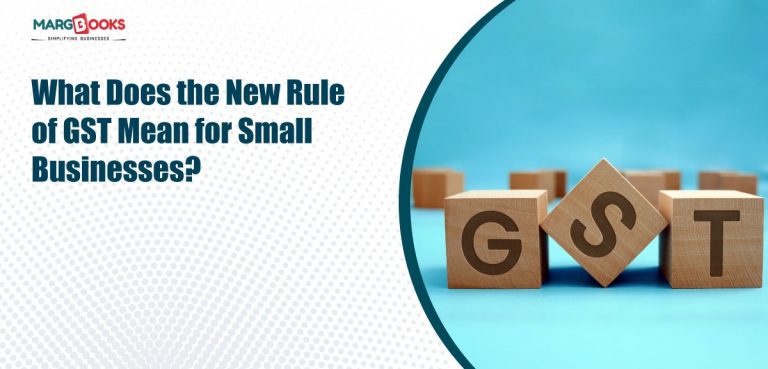
If you’re running a small shop, a trading business, or even a homegrown brand, chances are you’ve heard about the new rule of GST rule making headlines. But what exactly is it? And more importantly, does it affect your daily work?
Whether you’re a Kirana store owner in Nagpur, a textile trader in Surat, or a food wholesaler in Chennai, this update could change how you handle your billing, filing, and reporting. Let’s break it down in a simple, no-jargon way, so you know what to expect and what to do next.
What Does the New Rule of GST Say?
The new rule of GST introduced by the government focuses on stricter e-invoicing requirements for small and medium businesses. Earlier, only businesses with a turnover above ₹10 crore had to issue e-invoices. Now, this threshold has been reduced to ₹5 crore.
So, what changes for you?
If your annual turnover is ₹5 crore or more, you now must generate e-invoices for every B2B sale. This applies to:
- Wholesale traders
- Manufacturers
- Service providers
- E-commerce sellers
For many small businesses, this is a big shift. It means your invoices must be uploaded to the GST portal and validated through the government’s Invoice Registration Portal (IRP). Without it, your invoice is technically invalid.
Why This Matters to Indian SMEs?
Let’s say you run a small FMCG distribution business in Delhi and have just crossed ₹5 crore in turnover. Without e-invoicing, your GST returns may be rejected, input tax credit may get delayed for your buyers, and you might even face penalties with Online invoice software.
Or consider a pharmacy chain in Bengaluru, till now, they’ve been using manual invoice books. Now, they need to digitise, fast. That’s where software, MargBooks comes in handy. It automates e-invoicing, filing, and compliance, so you don’t get tangled in paperwork.
Still Below ₹5 Crore? Here’s What You Should Know
Even if the new rule of GST doesn’t apply to you yet, it’s wise to get into the digital mindset. The government is slowly but steadily lowering the threshold. You don’t want to be caught off guard when it dips to ₹1 crore.
This is also the time to explore digital tools that can ease the journey.
Try using an Online invoice software that’s GST-compliant, cloud-based, and easy for your staff to learn. Many Indian businesses, from fabric wholesalers in Ahmedabad to electronics traders in Ludhiana, are adopting these tools to stay future-ready.
How to Stay Compliant (Without Losing Sleep)?
Here’s the good news: adapting isn’t as painful as it seems, if you act early.
Steps to follow if the rule applies to you:
- Check your turnover: If you’re close to ₹5 crore, start preparing anyway.
- Register on the IRP: You’ll need a valid GSTIN and access to the e-invoice system.
- Choose your software: Use a solution like ours that connects directly to the portal.
- Train your team: Even basic staff must know how to handle digital invoices.
- Test a few invoices: Try generating and uploading sample e-invoices before going live.
These steps will save you headaches later. A retailer in Surat, for example, recently switched to MargBooks and now generates e-invoices in under a minute, right from his billing screen.
The Role of GST Billing Software in This Shift
To keep up with these rules, many SMEs are moving away from manual billing. A GST billing software doesn’t just help with tax, it makes day-to-day billing smoother, tracks stock, and automates returns.
Take the example of a stationery distributor in Pune. He was juggling three spreadsheets and handwritten bills until he moved to our software. Now, with built-in GST validations and auto-invoice generation, his operations are faster and far less stressful.
Why MargBooks is a Smart Pick for Indian SMEs?
So why are thousands of small business owners choosing our software?
- It’s designed for Indian GST laws
- Simple enough for non-tech teams
- Auto-syncs with the IRP for e-invoice generation
- Tracks input tax credit and filing deadlines
- Works on desktop and mobile
And because it’s built by Marg ERP (which has 30+ years of experience in this space), you’re not betting on a new or untested name.
Conclusion
The new rule of GST is more than just a technical update, it’s a signal that digital compliance is becoming the norm for even smaller businesses in India. If your turnover is ₹5 crore or more, e-invoicing is now mandatory. If you’re under it, start preparing anyway. Use tools such as MargBooks to make the transition smoother, and consider upgrading to a reliable GST billing software. Change is here, but with the right approach, it doesn’t have to be overwhelming.

MargBooks, a product of Marg ERP Ltd., is a revolutionary cloud-based billing & accounting solution for every business where the business owner can manage the business from anytime anywhere on any device. MargBooks is your one-stop platform for managing your accounting, organizing your transactions, controlling your finances and managing your inventory. It’s a single secure platform to keep up with your company’s bills and invoices, reconcile your transaction, file GST return easily, experience connected banking etc.