Retail Software
 Distribution Software
 Retail Chain


Tax Invoice vs Proforma Invoice – What’s the Difference and When to Use Each?

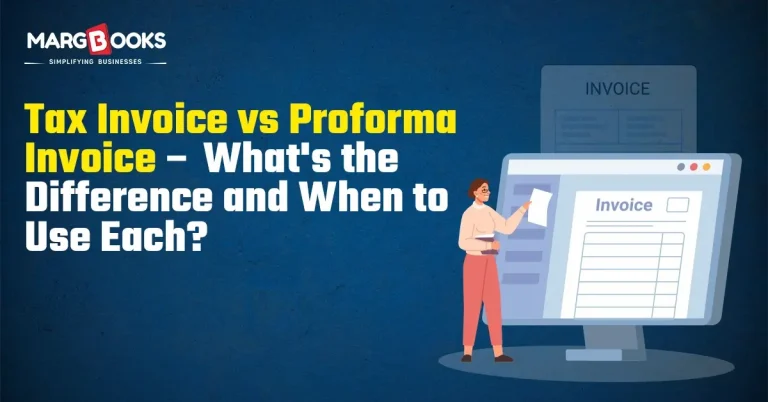
If you have ever sent the document to a client and then had to follow up with a sorry message saying “please ignore that, here is the correct Tax invoice or proforma invoice”. This post is for you. Tax invoices and proforma invoices may look similar when you first look at them. They are really different. Tax invoices and proforma invoices have different purposes. Under India’s GST rules, it can cause problems with not following the proper rules of the respective invoices. So let us just sort out Tax invoices and proforma invoices once and for all.
What Is a Proforma Invoice?
A proforma invoice is like a quote. You give it to the buyer before they pay, before you send the goods, and before you finalize the deal. It shows the buyer what they will pay in tax and the breakdown. Imagine you have a business in Surat that exports goods. A buyer from Dubai contacts you to buy a quantity of your product. Before they pay or get an import permit, they need a document that shows the costs. That document is a proforma invoice. It is not a bill. It is like a written agreement. There is no GST liability, with a proforma invoice. It is not a binding document. Using an invoicing software can help you with this, as they have customised templates where you just need to fill in the figures. It is a formal way of saying “here is the deal before we make it official.”
What Is a Tax Invoice?
Once the deal is done, goods delivered, service completed, that’s when the tax invoice comes in. This one is official. It’s legally binding. And if you’re GST-registered, it’s not optional. The tax invoice is what goes into your GST returns. It’s what your buyer needs to claim Input Tax Credit. It has to include your GSTIN, the buyer’s GSTIN (in B2B cases), HSN or SAC codes, the correct GST breakup, CGST and SGST for within the state, IGST for interstate, and a sequential invoice number that you can’t just randomly assign. Miss any of this, and either your returns don’t match up, or your buyer loses out on ITC. Neither outcome is fun.
Key Differences between Tax Invoice and Proforma Invoice
In this section, we are providing the list of key differences between a tax invoice and proforma invoice.
| Feature | Tax Invoice | Proforma Invoice |
| When issued | After sale/delivery | Before sale confirmation |
| Legal status | Legally binding | Not legally binding |
| GST liability | Yes | No |
| ITC claim by the buyer | Yes | No |
| Mandatory under GST | Yes | No |
When to Use Which
In this section, we are giving a way to use a tax invoice and proforma invoice.
Send a proforma invoice when:
- A buyer wants confirmed pricing before placing an order
- You need an advance, but the work hasn’t started yet
- You’re dealing with international buyers who need documentation for customs or forex
- You want sign-off on the scope before committing to a bill
Send a tax invoice when:
- Goods are dispatched, or services are wrapped up
- You need to record the sale in your GST returns
- Your buyer needs to claim ITC
- It’s an interstate transaction — IGST must be captured correctly
Why Getting This Wrong Actually Costs You
The classic mistake small business owners make, and it happens more than you’d think, is raising a tax invoice too soon. The second that invoice goes out, GST liability is triggered. Which means you owe that tax to the government, whether or not your client has paid you yet. If they take 60 or 90 days to clear the bill, you’ve been funding that GST from your own pocket the whole time.
Going the other way is just as bad. If you’re raising proforma invoices in situations that legally require tax invoices, your sales records won’t line up with your GST filings. An officer doing a routine check will catch that fast. However, using a cloud billing software can help to maintain a workflow were proforma is sent at first, followed by a tax invoice.
A Word on Doing This Without Losing Your Mind
Here’s the truth: once you have a decent volume of transactions going, tracking all of this manually is a nightmare. Which invoice was a proforma, which was final? Did you use the right GST rate? Is the numbering sequential? It piles up fast.
A lot of businesses in India have quietly moved to invoicing software to handle exactly this. Platforms like MargBooks let you manage both proforma and tax invoices from one place, with GST rates pre-configured and invoice numbering that takes care of itself. Small traders in Chandni Chowk use it. Manufacturers in Pune use it. Even service businesses that just need clean, GST-compliant billing without the headache.
It’s not about the software being fancy, it’s about not having to think twice every time you raise a bill. Whether it’s a retail shop that needs fast cloud billing software or a B2B company managing bulk orders with proper ITC trails, having one system that gets it right quietly in the background makes a real difference.
Conclusion
A proforma invoice is a promise “here’s what you’ll pay.” A tax invoice is the record — “here’s what you paid.” One comes before the transaction, one comes after. Both matter, but only one has legal and tax consequences. Knowing which one to use is quite tough, that’s where MargBooks software comes into the picture, it provides customised invoice templates so that you can send them at the right time, and half your GST headaches disappear on their own.

MargBooks, a product of Marg ERP Ltd., is a revolutionary cloud-based billing & accounting solution for every business where the business owner can manage the business from anytime anywhere on any device. MargBooks is your one-stop platform for managing your accounting, organizing your transactions, controlling your finances and managing your inventory. It’s a single secure platform to keep up with your company’s bills and invoices, reconcile your transaction, file GST return easily, experience connected banking etc.