Retail Software
 Distribution Software
 Retail Chain

Why Sales Order Processing is Important for Accurate Billing and Delivery?

Every sale starts with a promise to provide the right product to the right price and time. That promise is fulfilled through Sales Order Processing. It links together the sales, inventory, accounts and logistics into a single controlled workflow. If this process is weak, then there will be billing errors, risk of reporting of GST, delayed deliveries, etc.
The reason for Indian MSMEs to lose revenue is not because of poor sales but due to process gaps. Structured system to be certain that all the confirmed orders are transformed into correct invoice and cogent dispatch. That is why Sales Order Processing should be disciplined and is important for financial and operational control.
What is Sales Order Processing?
The sales order processing is the process of following a customer order, creating a confirmed sale, invoice and delivery in a systematic manner. It starts from placing an sales order processing by a customer. This is not a mere sales activity. It is a coordinated process of workflow between:
- Sales team
- Warehouse
- Accounts department
- Dispatch team
- GST compliance staff
A proper process provides a documented path of trail for billing and tax reporting.
Key Stages in Sales Order Processing
Order Receipt
The process begins where a customer sends:
- Purchase order
- Email confirmation
- WhatsApp order
- Online portal request
Details need to be written down with precision:
- Product name
- Quantity
- Rate
- GST rate
- Delivery address
Order Verification
Manual mistakes at this stage cause mistakes in invoices. The sales team verifies:
- Customer credit limit
- Outstanding balance
- Agreed pricing terms
- Tax applicability
This avoids any disputes and bad debts. Using a reliable system has the advantage of reducing the need for manual checks.
Inventory Check
Stock availability is then checked prior to confirmation. The warehouse checks:
- Available quantity
- Batch details
- Expiry dates in case of perishable goods
- Reserved stock
If there is not a sufficient stock, production or procurement is triggered. Accurate data facilitates the prevention of over-commitment.
Order Confirmation
After verifying and validating the stock, the order is confirmed. A sales order document is prepared containing:
- Unique order number
- Item details
- Price
- GST breakup
- Delivery schedule
Systems such as MargBooks software help to keep documentation traceable.
Invoice Generation
Once goods have been prepared, the invoice is prepared. The invoice must include:
- Correct GST rate
- HSN or SAC code
- Place of supply
- Tax breakup
- Invoice number according to the GST Rules.
Our MargBooks software will ensure compliance and calculate the values of tax correctly with auto calculators. Incorrect Invoices give rise to issues of GST mismatch and reconciliation.
Dispatch and Delivery
After invoicing:
- An e-way bill is generated if it is required
- Goods are packed
- Transport is arranged
- Dispatch information is recorded
The operational cycle is closed on delivery confirmation. In MargBooks software, the dispatch and the billing records stay linked, and it provides help in the audit tracking.
Why Sales Order Processing is Critical?
Each invoice is based on order data. If the order is placed wrong:
- Quantity
- Rate
- GST rate
The invoice will also be incorrect.
Accurate Sales Order Processing guarantees:
- Correct tax calculation
- No duplicate billing
- No under-billing or over-billing
- Clean ledger posting
This reduces the manual correction entries.
GST Compliance
GST compliance depends on:
- Proper invoice numbering
- Correct tax classification
- Timely reporting in GSTR-1
A mismatch between the order and the invoice creates reconciliation issues. Using structured workflows in GST billing software helps to eliminate such risks and keep your documentation GST-ready.
Inventory Control
Inventory does not move further when a sales order is confirmed. Without proper tracking:
- The same stock may be promised to two customers.
- Negative stock situations happen.
- Production planning gets affected.
Integrated systems help avoid reporting misstock.
Customer Satisfaction
Customers expect:
- Correct pricing
- On-time delivery
- No billing disputes
If errors are made on the invoices or goods are delivered late, trust is down. A disciplined process helps repeat business get better.
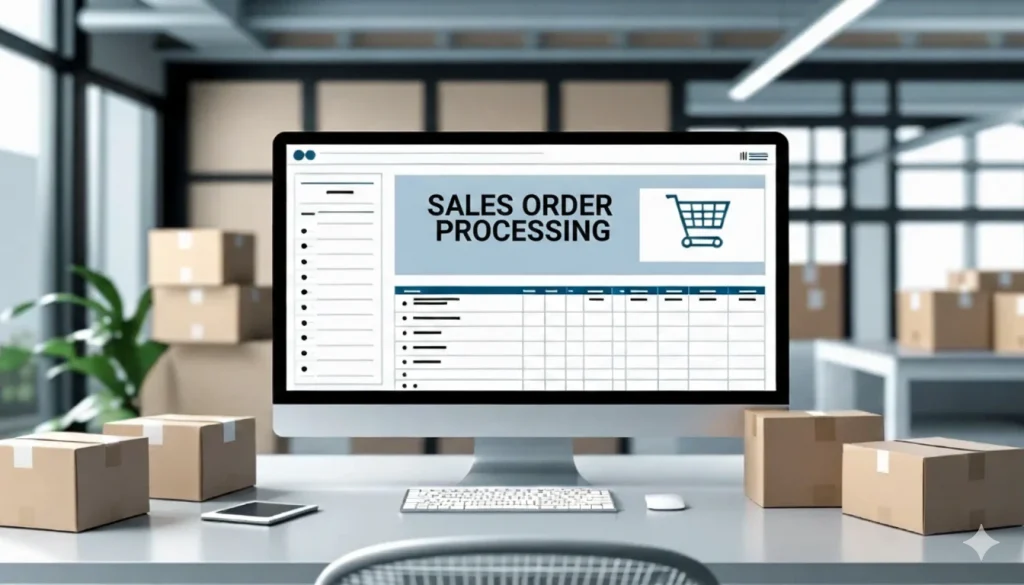
Revenue Tracking
Sales orders serve as a forecast of incoming income. Management can track:
- Pending orders
- Confirmed sales
- Dispatch status
- Outstanding invoices
This helps to improve the cash flow planning.
Risks of Poor Sales Order Processing
Weak control leads to:
- Incorrect invoices
- Wrong product delivery
- Delayed shipments
- Customer disputes
- Revenue loss
- GST penalties
Manual registers and scattered spreadsheets are the reasons for these increased risks. Even small errors build up over time. Consider a wholesale dealer in electricity who deals in Ahmedabad.
Practical Example: Wholesale Electrical Trader in India
The sales team is given a bulk order for:
- 500 switches
- 300 LED bulbs
Order entry is manual.
Problems arise:
- The stock of switches is only 400 units.
- The wrong GST rate is used.
- A wrong quantity invoice is generated.
- The customer gets a partial shipment without any prior intimation.
This results in:
- Debit note
- GST correction
- Extra transport cost
- Delayed payment
If the trader employed structured Sales Order Processing in the MargBooks software:
- Inventory shortage would be evident.
- GST would auto calculate correctly.
- Backorder could be generated
- Invoice and despatch would correspond
The monetary loss and controversy could have been prevented.
Standardize Documentation
Develop consistent sales order forms. Include:
- Order number
- Customer code
- Tax details
- Delivery commitment
Integrate Departments
Sales, warehouse, and accounts have to work on a common system. Disconnected tools give rise to data gaps. A centralised system means there is less duplication.
Use Structured Technology
Implement reliable invoicing software that supports:
- Order-to-invoice linkage
- Real-time stock update
- GST compliance
- Ledger integration
Do not duplicate by hand between the Billing and Stock register systems
Automate GST Checks
A reliable software ensures:
- Correct HSN mapping
- Auto tax calculation
- E-way bill support
- Clean return data
This reduces the risk of compliance.
Monitor Order Status
Track:
- Pending confirmation
- Ready for dispatch
- Delivered
- Invoiced
Regular review helps to avoid delays.
Conclusion
Strong Sales Order Processing helps to protect the revenue, ensure accurate billing, and facilitate delivery. It links sales commitments to stock availability, compliance of GST and accounts. Without being controlled, businesses risk errors in invoicing, delays in dispatching, customer disputes and risks of noncompliance with taxation. Indian MSMEs should not ignore order processing as a financial control function but not merely a sales activity.
Having disciplined work flows and using reliable systems such as MargBooks software aid in the maintenance of data accuracy and clarity of operations. When every confirmed order runs smoothly to invoice and delivery, the growth of the business becomes predictable and financially stable.