Retail Software
 Distribution Software
 Retail Chain

Looking for a ProfitBooks Alternative? 6 Best Competitors Compared in 2026


Switching accounting software is a pain. Anyone who’s done it knows that. You don’t switch unless something is genuinely bothering you a missing feature, a workflow that wastes your team’s time every single day, or support that leaves you hanging when you actually need help.
If ProfitBooks has been that painful for you, you’re in good company. A lot of businesses, especially in retail, distribution, and trading start with ProfitBooks and then hit a ceiling at some point. The ceiling looks different for everyone. For some, it’s the missing E-Way Bill. For others, it’s the lack of POS or barcode support at the counter. For many, it’s just the fact that the software wasn’t really built with Indian business operations in mind. This guide covers seven alternatives people are actually switching to in 2026. However, here is a quick glance based on the same.
If You Just Want the Quick Answer
- MargBooks — Best all-round switch for retail, distribution, and SMEs
- TallyPrime — If accounting depth is your top priority
- Zoho Books — If you live in the Zoho ecosystem
- Vyapar — Simple and affordable for small shops
- myBillBook — Just getting started? Begin here
- Busy Accounting — Trading and manufacturing with complex inventory
What’s Actually Pushing People Away from ProfitBooks?
It’s rarely one big thing. It’s usually a slow build-up of smaller frustrations.
You need to generate an E-Way Bill, but ProfitBooks doesn’t do it, so you’re switching tabs and doing it separately on the government portal. Every single time. You want to scan barcodes at the counter, but it’s not possible. You want to ping a customer their invoice on WhatsApp the moment billing is done, nope. You open a second branch, and suddenly you’re running two separate setups with no unified view.
Then there’s the inventory side. If you’re in pharma or FMCG, you need batch-wise and expiry-wise tracking. ProfitBooks doesn’t go there. If your internet goes down mid-day, billing stops. And if something breaks and you call support, a lot of users say the experience is underwhelming, especially when your question is specific to your trade.
None of these is a deal-breaker for everyone. A significant portion of the extra costs stems from the rapidly increasing expenses associated with a retail or distribution business that is actually expanding.
Comparison between Top Alternatives
| Software | Best For | Cloud Based | GST Compliant | Mobile App |
| MargBooks | Retail, distribution, SMEs | Yes | Yes | Yes |
| TallyPrime | Accounting-heavy teams | Partial | Yes | Limited |
| Zoho Books | Service businesses | Yes | Yes | Yes |
| Vyapar | Small retailers | Yes | Yes | Yes |
| Marg ERP 9+ | Pharma, FMCG | Partial | Yes | Limited |
| myBillBook | Micro businesses | Yes | Yes | Yes |
| Busy Accounting | Trading, manufacturing | Partial | Yes | Limited |
The 6 Best ProfitBooks Alternatives
1. MargBooks — Best Overall Switch from ProfitBooks
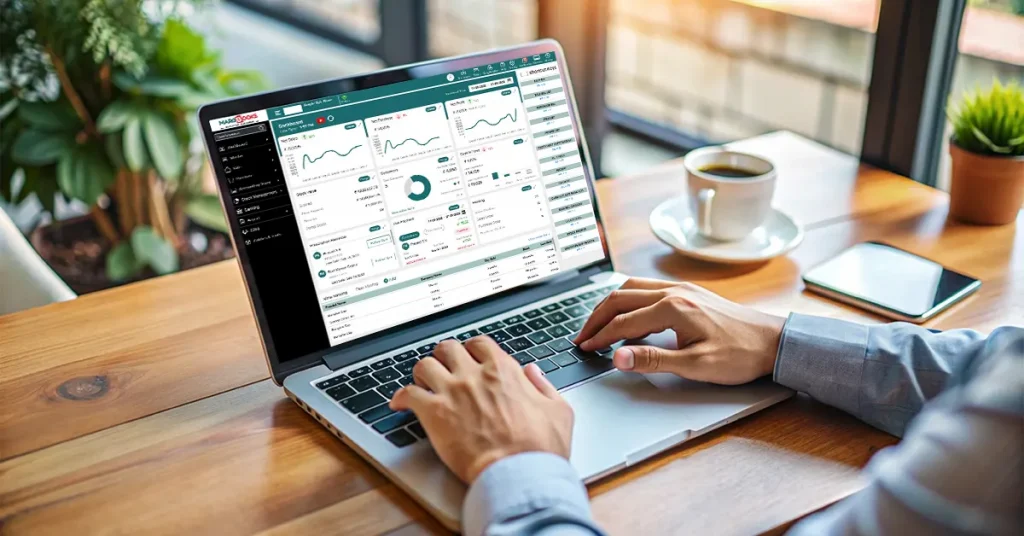
MargBooks — a company that’s been building GST billing software for Indian businesses for over 32 years. That kind of history tends to show up in the right places. The software doesn’t just tick compliance boxes; it’s been shaped by how retail shops, pharma distributors, FMCG wholesalers, and multi-branch businesses actually operate day to day.
The things that trip you up in ProfitBooks? Most of them have a native answer in MargBooks. Barcode scanning at the counter is built in. E-Way Bill generation without leaving the software — done. Send an invoice on WhatsApp, the second billing is complete — one tap. Running two or three branches and want a single dashboard view — that’s standard, not an add-on.
Offline mode is really beneficial. You can invoice your customers, even when there is a poor internet connection, and the invoices will sync automatically when you have an internet connection to your customers again. If your business is located in a smaller town or a location that only has intermittent internet connectivity, this is no longer a want but a need. Marg’s team handles the data migration end-to-end. Your invoices, customer records, ledgers, and stock data all come over. You don’t start from zero.
What it covers:
- GST billing with automated return filing
- E-invoicing and E-Way Bill without switching portals
- Inventory with batch and expiry tracking
- POS and customisable barcode scanning
- WhatsApp billing
- Home delivery management
- Multi-branch management from one place
- Offline billing with automatic sync
- Bank reconciliation
- Mobile app that mirrors the full desktop experience
The honest downside
If you’re a very small business doing basic invoicing and nothing else, the feature range might feel like more than you need right now. Setup takes a bit of time — though the support team walks you through it.
Who should use it
Retailers with one or more locations, pharma and FMCG distributors, wholesalers, and businesses that have clearly hit the ceiling on ProfitBooks and need room to grow.
2. TallyPrime
Tally is one of those products that people either swear by or find frustrating — and which camp you fall into usually depends on whether you’re the accountant or the business owner.
For CAs and finance teams, TallyPrime is deeply familiar territory. The accounting logic is rock solid, the compliance reporting is thorough, and the audit trail is the kind of thing that keeps your CA happy. If your primary goal is clean books and detailed financial reporting, Tally has earned its reputation.
The cloud business management software was originally an accounting software, not a whole business management software platform; so the cloud technology appears to have been added as a later development rather than a native built solution. The mobile experience is limited. Modern workflows, POS billing, WhatsApp invoices, and barcode scanning at the counter just aren’t what Tally was built for.
What works:
- Deep accounting and ledger management
- GST compliance and detailed statutory reports
- Multi-company support
- Reliable audit trail
- Payroll modules
What doesn’t
Cloud access needs add-ons and extra configuration. Mobile functionality is thin. Retail-specific features aren’t really there.
Right for
In some companies, the accountant or CA is the main user and there’s an emphasis on having the correct financial side rather than operational side features.
3. Zoho Books
If you’re already using Zoho CRM, Zoho Inventory, or other Zoho products, Books fits into that world cleanly. The interface is modern, the mobile app works well, and for service businesses or consultants who need professional invoicing, expense tracking, and client portals — it genuinely delivers.
The GST compliance is competent for the most part, and the multi-currency support makes it a reasonable option for businesses dealing internationally.
Where it starts to struggle is with product-based businesses. Inventory features exist but they’re fairly basic. There’s no POS, no barcode scanning, and no E-Way Bill generation built in. If you’re selling physical products across a counter or managing a warehouse, you’ll bump into limitations fairly quickly.
What works
- Clean, modern interface
- Good cloud and mobile experience
- Time tracking and project billing
- Multi-currency support
- Tight integration across the Zoho suite
What doesn’t
Inventory is shallow. No POS or barcode support. E-Way Bill isn’t there. Not built for retail or distribution operations.
Right for
Agencies, consultants or service-based businesses who use the Zoho platform, may find that they would like a seamless account (i.e. have an accountant connect their bank statement with very little effort), for low-cost software.
4. Vyapar
Vyapar figured out something that a lot of software companies miss — for small Indian business owners, simplicity is a feature in itself. You don’t want a manual. You want to open the app and raise an invoice in two minutes.
It does that well. GST billing, basic inventory, payment reminders, offline access — the core things a small retailer or solo trader needs are there, and they work without frustration.
The ceiling becomes visible when you grow. If a company needs to track its inventory in different locations, requires batch tracking and detailed reports, or has a distribution level of stock, then Vyapar will not be able to accommodate that, nor does it have any intention of doing so. A single shop could use its product and be satisfied with it, but once they need something more than just a single shop, they will outgrow it.
What works
- Genuinely easy to use from day one
- Offline functionality
- Affordable pricing
- Good Android app
- Basic GST and inventory covered
What doesn’t
Reporting is limited. No multi-branch support. Advanced inventory features are missing. Not suited for distribution or pharma.
Right for
Small retail stores, local merchants, and independently owned business owners are looking for billing software that can help them run their business smoothly without having to worry about technology getting in the way of running a successful business or making their lives more difficult because of technology problems.
5. MyBillBook
MyBillBook is the entry point of this list. It’s for businesses that are just formalising — moving from handwritten invoices or WhatsApp notes to something structured for the first time.
It does basic GST invoicing, tracks expenses at a surface level, sends payment reminders, and has a simple mobile app. That’s about the scope of it. It won’t scale with a growing business, and it doesn’t try to.
What works
- Very simple, no learning curve
- Low cost
- GST invoicing done
- Mobile-friendly
What doesn’t
Not much beyond basic billing. No advanced inventory, no compliance automation, no room to grow.
Right for
A “Micro Business” is a category of businesses that sell their products directly to customers from their homes, or for individuals that are just starting out on their path to become digital billers and need a very simple starting point (or digital billing solution).
6. Busy Accounting
Busy has a specific audience — trading companies, manufacturers, and businesses with complex multi-location inventory — and for that audience, it’s genuinely capable software.
The depth of inventory management, warehouse handling, manufacturing job work, and financial reporting is serious. It handles scenarios that most cloud-native tools would struggle with. The trade-off is that the interface is functional but not modern, cloud capabilities are limited, and the learning curve is real.
If you’re running a single retail shop, Busy is overkill and probably the wrong choice. But if you’re managing multiple godowns, tracking stock movements across locations, or dealing with manufacturing workflows, it’s worth a serious look.
What works
- Complex multi-location inventory and godown management
- Manufacturing and job work modules
- Detailed financial and MIS reporting
- Multi-currency support
- Solid accounting depth
What doesn’t
Interface is dated. Cloud access is limited. Not suited for retail counter billing or mobile-first teams.
Right for
Trading companies and manufacturers with complex inventory structures who need serious back-end power, even if it means a steeper learning curve.
How to Actually Decide
Skip the feature checklists for a second and think about this: what is the one thing that’s frustrating you most about ProfitBooks right now?
If it’s E-Way Bills, POS, barcode scanning, multi-branch management, or offline access — MargBooks fixes all of those and is the cleanest upgrade path for most businesses in retail and distribution.
If it’s accounting depth and your CA keeps asking for better reports — TallyPrime is the answer.
If you’re a service business already using Zoho products — Zoho Books is the obvious choice because it slots right in.
If you’re a small retailer who just wants billing to be simpler and cheaper — Vyapar is hard to beat at that price point.
If you’re just starting out — myBillBook gets you going without overwhelm.
If you’re in trading or manufacturing with complex inventory — Busy has the depth you need.
Conclusion
Most businesses searching for a ProfitBooks alternative aren’t looking for something fancier. They’re looking for something that handles their actual day-to-day without the workarounds — E-Way Bills that generate automatically, inventory they can actually trust, billing that keeps working when the internet cuts out, and support that understands their industry.
For the majority of retail and distribution businesses, MargBooks software covers all of that and more. It’s not perfect for every situation nothing is but the feature gaps it closes compared to ProfitBooks are significant, and the migration support makes switching less daunting than it looks.
Manufacturers and merchants with large, complicated inventories are best served by Busy and for smaller, simple businesses, Vyapar is also a great option to consider.
FAQs
What’s the best ProfitBooks alternative?
For most retail and distribution businesses, MargBooks. It directly addresses the biggest gaps in ProfitBooks — POS, E-Way Bill, barcode scanning, WhatsApp billing, offline access, and multi-branch management. If accounting depth is the main concern, TallyPrime. If you’re a service business on the Zoho stack, use Zoho Books.
Who are ProfitBooks’ main competitors?
The primary accounting software options in 2026 include MargBooks, TallyPrime, Zoho Books, Busy Accounting, and MyBillBook. Each solution targets a unique type of customer; therefore, the ideal solution depends largely on the work performed by your organization as well as the size of your organization.
Is there a proper cloud-based replacement for ProfitBooks?
MargBooks and Zoho Books are both fully cloud-based. MargBooks also has offline mode with automatic sync — which is a meaningful advantage if your internet isn’t always reliable.
Which alternative works best for small businesses?
Vyapar and myBillBook for very small or early-stage businesses. If you want something that won’t need replacing again in a year as you grow, MargBooks is worth starting with even at smaller scale.
Which is best for retailers specifically?
MargBooks offers comprehensive in-house solutions designed specifically for Point-of-Sale activity (retail), Barcode Scanning, WhatsApp invoicing, Multi Location Facility Management, and Integrated Solutions. Vyapar is specifically geared to meet the demands of single-location retailers with basic functionality.
Can you actually migrate your data from ProfitBooks to MargBooks?
Yes. Marg’s team handles the migration end-to-end invoices, ledgers, stock records, and customer data. You don’t start from scratch, and nothing gets lost in the process.

Aman Kannojia is the Digital Team Lead at MargBooks. He started out as an SEO Specialist and never lost his love for words. With 5 years of experience across banking, SaaS, and finance, both domestic and international, he brings strategy, leadership, and storytelling together. He doesn’t just manage a team, he builds one that creates.