Retail Software
 Distribution Software
 Retail Chain

Invoice vs Receipt: Which One Comes First?

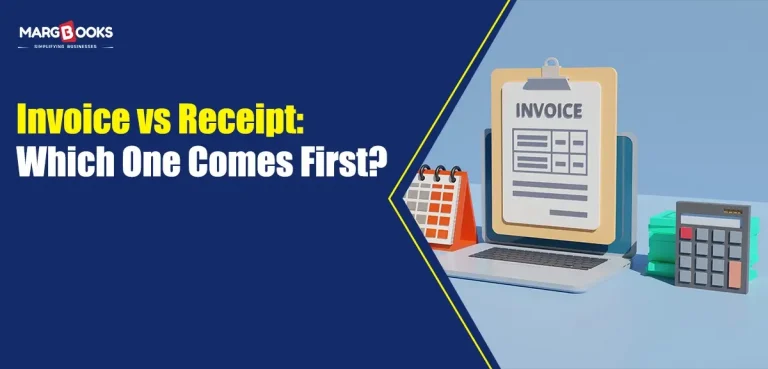
Confusion between Invoice vs Receipt is very common in Indian business. Both documents are related to sales and payments, though they are different from a legal and accounting perspective. Issuing them in proper order ensures proper GST compliance, proper reporting of revenue and clean bookkeeping. Retailers, manufacturers, service providers, and MSMEs need to be aware of the situations in which to generate an invoice and a receipt.
The sequence is dependent on the nature of the transaction. It also has an impact in journal entries, GST liability, financial statements. This blog explains what the difference with the help of Indian practical scenarios.
Understanding Invoice
An invoice is a bill for money made by a seller to a buyer. It tracks information on goods, supplies, or services rendered. Key elements of an invoice are as follows:
- Seller and buyer details
- GSTIN of both parties
- Invoice number and date
- Goods or services description
- Value with tax and GST breakup
- Total amount payable
Under the GST law in India, tax invoice must be issued before or at the time of supply of goods. For services, it needs to be issued within the prescribed time limit. An invoice represents a receivable in the books of the seller. It does not confirm payment.
Understanding Receipt
A receipt is proof of a payment made. It confirms that money has been collected against an invoice, advance or sale. A receipt generally consists of:
- Date of payment
- Amount received
- Mode of payment
- Reference to invoice no., if any
Confirmation by signature or system-generated information.
Unlike an invoice, a receipt closes down or decreases a receivable. It confirms the settlement.
When is an Invoice Issued?
1. Credit Sales
A manufacturer of Gujarat sells his goods of amount ₹1,00,000 plus GST to a distributor on 30 days credit. The date of the invoice is the date of supply. Payment will come later.
2. Service Billing
A consultant performs a project and sends out an invoice for professional fees. Payment for it may be received after 15 or 30 days.
3. E-commerce Order Dispatch
When goods are sent to a customer an invoice is generated along with a shipment. In all such cases, the invoice comes first.
After Payment Against invoice
Once the distributor pays the outstanding amount, a receipt is generated to him acknowledging the payment.
Cash Sales in Retail
In case of a supermarket sale that is paid on the spot by UPI or cash:
- Payment and invoice occur at the same time.
- A receipt is generated in an instant.
Advance Payment for Services
If a client has paid an advance before taking service:
- A receipt voucher is issued first.
- Tax invoice can be issued after the GST rules.
In advanced cases, the receipt can come first, under the Invoice vs receipt.
Situations in Which Receipt Takes Priority
- Advance received for construction contract.
- Amount received on booking for event management.
- Subscription fees obtained prior to service period commencing.
Under GST advance receipts may attract liability to taxation subject to the nature of supply. On the date of receiving advance, a receipt voucher is to be issued.
Situations Where Invoice Comes First
- Credit sale of goods
- Professional services billed after completion
- B2B manufacturing supply
In this case, GST is payable under the time-of-supply rules. Payment may follow later.
GST Impact in Invoice Vs Receipt
Under GST law:
- Tax invoice is used as a means of determining tax liability in respect of most goods transactions.
- For services, time of supply rules determines liability.
- Advance receipts for services could attract GST at receipt stage.
Having proper documentation to report in GSTR-1 and 3B correctly. On using the GST billing software, mismatches between invoice data and return filing are reduced. Our system assists in the automation of invoice numbering, tax calculation, and receipts tracking without the need of human error.
Revenue Recognition
As per accounting standards:
- Revenue is acknowledged when the control of the goods or services is passed on to the customer.
- Receipt of money does not always mean revenue recognition.
One of the purposes of understanding the difference between an invoice vs receipt is to avoid overstating the value of income or delaying the receipt in your financial statements.
Practical Scenarios of Business
- Customer buys groceries.
- Invoicing generated instantly.
- Payment collected immediately.
- Receipt printed on the bill.
At this point, invoice and receipt take place simultaneously.
Manufacturer – Credit Sale
- Invoice issued on dispatch.
- GST liability arises.
- Payment received after 30 days.
- Receipt on the realization issue.
The invoice clearly comes first.
Service Provider – Upfront Payment
- Client pays 50 percent advance.
- Receipt voucher issued.
- GST can be on advance stage.
Final invoice for payment after service is completed. Receipt is earlier than invoice.
E-commerce Platform
- Invoice created as soon as shipment occurs.
- Payment may be on a prepaid basis or cash on delivery basis.
- Receipt given on verification of payment.
Modern accounting software is useful to track each stage accurately. It helps businesses to automatically match invoices to receipts. It takes care of making sure no outstanding payment is missed. MSMEs also use MargBooks software which makes debtor ageing reports easy. Proper marginal books configuration supports GST compliance and clean ledger management.
Why Invoice vs Receipt Sequence is Important?
Wrong order of sequencing causes:
- GST mismatch
- Overstated revenue
- Debtor confusion
- Audit objections
Businesses need to bring their business practices into alignment with the rules of GST and also with accounting practices. A structured billing workflow avoids any mistakes.
Conclusion
Understanding the difference between an invoice vs receipt is crucial for proper bookkeeping mechanisms and complying with the Goods and services tax in India. An invoice demands payment and a receivable is created. A receipt is used to verify the receipt of money and takes care of the receivable. In case of a credit sales it will be invoice first. In advance payment cases, receipt may precede.
Correct journal entries are responsible to develop and report revenue and also to report taxes. Businesses that follow structured systems under the MargBooks software that do not report errors and keep their financial records transparent. Clear with Invoice vs Receipt, MSMEs can be safeguarded by it from compliance risks and easy-to-finance reporting.

MargBooks, a product of Marg ERP Ltd., is a revolutionary cloud-based billing & accounting solution for every business where the business owner can manage the business from anytime anywhere on any device. MargBooks is your one-stop platform for managing your accounting, organizing your transactions, controlling your finances and managing your inventory. It’s a single secure platform to keep up with your company’s bills and invoices, reconcile your transaction, file GST return easily, experience connected banking etc.