Retail Software
 Distribution Software
 Retail Chain

How Can GST Billing Software Replace Manual GST Bill Template?

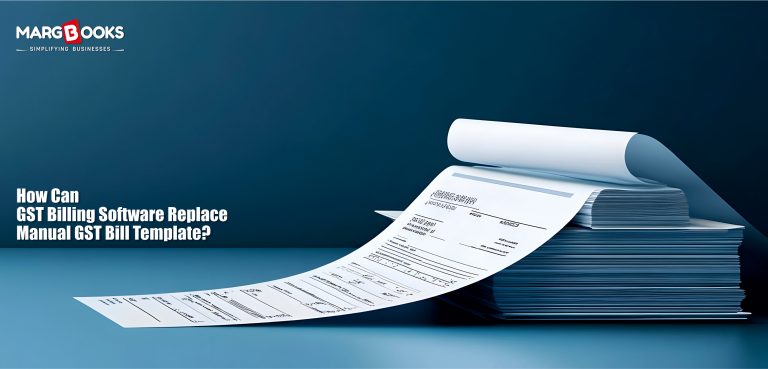
Goods and Services Tax (GST) has brought uniformity and clarity, but it also demands meticulous compliance. For years, many small and medium enterprises (SMEs) have relied on manual GST Bill Templates, often created using Excel or Word, to manage their invoicing.
However, with digital transformation making inroads into even the smallest businesses, it’s time to ask the obvious: Is it still practical to rely on manual billing? Or, more importantly, can GST Billing Software replace manual GST bill templates?
Manual GST Bill Templates – The Traditional Approach
Let’s face it: using a manual GST Bill Template is like walking a tightrope. Sure, it works, but one wrong step, a missing tax component, a calculation error, or an outdated rate can throw everything off balance.
Common Issues with Manual GST Bill Templates
- Prone to Errors: Manual entries often lead to miscalculations or wrong GST percentages.
- Time-Consuming: Creating each invoice from scratch can be tedious and repetitive.
- Limited Features: Templates are static; they don’t track inventory, payment status, or generate reports.
- No Automation: Things such as e-invoicing, GSTR filings, or payment reminders must be done separately.
In short, while templates serve the basic need of generating a GST-compliant invoice, they don’t support the overall billing ecosystem that today’s businesses require.
GST Billing Software – A Smarter Solution
The biggest game-changer is automation. Modern GST Billing Software has transformed the way businesses manage billing, tax compliance, and reporting.
So, what does a GST Billing Software bring to the table?
- Automation of Calculations: Eliminate human error with automatic GST and tax component calculation.
- Real-time Data: Track invoices, stock, and accounts in real-time.
- E-invoicing Integration: Seamlessly generate and share e-invoices as per government norms.
- GSTR Filing Support: Simplify GSTR-1, GSTR-3B, and other filings within the platform.
- Multi-user Access: Allow multiple employees to manage billing, with role-based permissions.
One such reliable and widely used solution is MargBooks, an Online GST Billing Software designed with Indian businesses in mind. It’s built not just to replace traditional billing, but to elevate the entire invoicing experience.
Why MargBooks Stands Out?
MargBooks isn’t just a billing tool, it’s an all-in-one business solution. Whether you’re a small retailer or a growing distributor, it provides everything you need in one place.
Key Features of MargBooks:
- Custom Invoice Designs: Ditch boring templates and design professional GST invoices.
- Inventory Management: Real-time stock updates with every invoice.
- Cloud Access: Since it’s an Online GST Billing Software, you can access it from anywhere, anytime.
- Bank Reconciliation: Automatically match transactions and streamline accounting.
- Data Security: Keep your billing data safe with encrypted cloud backups.
And here’s the best part, it’s user-friendly. You don’t have to be a tech wizard to use MargBooks. The dashboard is intuitive, and customer support is readily available for assistance.
GST Billing Software vs. Manual GST Bill Templates
| Feature | Manual GST Bill Template | GST Billing Software (e.g. MargBooks) |
| Calculation Errors | High risk | Automated & accurate |
| Invoice Design | Basic | Customisable & professional |
| Inventory Tracking | Not Available | Real-time updates |
| GST Return Filing | Manual entry | Auto-generated reports |
| Cloud Accessibility | Not possible | Available from any device |
| Data Backup | Manual & risky | Automated backups |
The Shift is Not Just Inevitable
With frequent GST rule updates and increasing demand for compliance, relying on a manual GST Bill Template feels like using a typewriter in a world full of laptops. It’s simply outdated.
Here’s what you gain by shifting to Online GST Billing Software such as MargBooks:
- Save Time: Automate repetitive tasks.
- Stay Compliant: Always use the latest GST rates and formats.
- Grow Your Business: Focus on expansion while the software handles back-end operations.
- Analyse Better: Use real-time reports and insights to make smarter business decisions.
Conclusion
Holding on to manual processes might cost more than you realize, not just in money, but in time, accuracy, and business growth. If you’re still stuck with the old-fashioned GST Bill Template, it’s time to rethink.
MargBooks is more than just a billing tool, it’s your business’s digital partner. From invoice creation to inventory, accounting, and GST filing, it does it all under one roof.